
… on borders in a war of systems
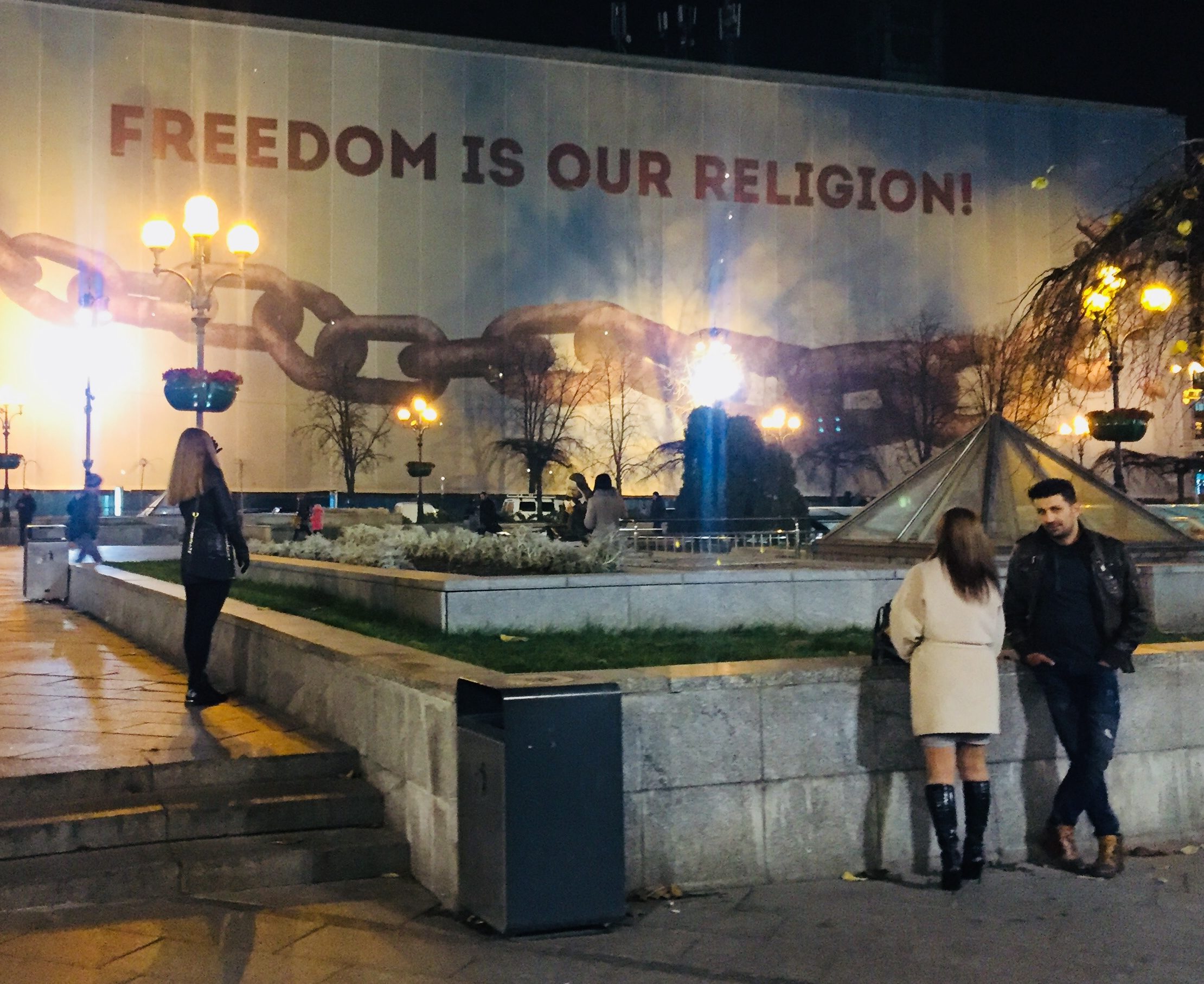
“Freedom is our religion!” – a powerful image, taken in November 2017 in the middle of Kyiv, four years after the start of the Euromaidan protests for freedom rights in Ukraine and three years after Russia’s annexation of Crimea in violation of international law.
The imagery is clear, freedom is understood as a religion and one fights for it in a country that geographically represents the largest buffer between Russia and Central Europe. For years, they have been at war with each other on the Russian-Ukrainian border, whose territories, especially around Luhansk and Donetsk, are heavily contested. With yesterday’s incursion of Russian forces into Ukrainian territory, borders are widely being crossed.
Borders of the territory of Ukraine, borders of international law, borders of freedom and peace. Borders, once created by fighting and today the starting point for new battles over borders, have always offered both potential for conflict and, conversely, served as a guarantor of peace and freedom.
War of the systems?
Not only for Ukraine, but also for countries such as Poland, Slovakia or the Baltic states, eastern state borders mean geographical as well as political security and demarcation. All these countries share a democratic system of government that Russia does not know under dictatorial leadership.
With the Russian invasion of Ukraine, borders are being crossed. It is a war that shakes peace and freedom, that geographically attacks Ukraine and Europe, and that politically is directed against liberal, democratic structures.
How far this war proves to be a “war of systems” remains to be seen.
Democracy confronts autocracy on the European frontier
International positions reinforce political support in each case for Ukraine, which symbolically stands for democracy, or for Russia, with which autocratic states show solidarity. Cuba or China, for example, back Russia, while the U.S., the EU, or countries such as the United Kingdom, Japan, or Kenya back Ukraine.
From the very beginning, this war does not only mean a threat to Ukraine or Europe, but it challenges positioning internationally:
Supporting democracies, liberal structures and international alliances created to preserve peace, freedoms and stability.
Turning to an autocratic counterweight, systems that instead of freedom today provoke war, trade stability for destruction, and break with international treaties.
Political risk management teaches one to first recognise what is at stake and in what ways one is vulnerably exposed to threats.
Today’s war situation is about nothing less than defending rules and borders that protect international stability, freedoms, and peace. What could internationally better serve as a guidepost than “Freedom is our religion”?

Contact Cassandra Foresight for more information and the management of political risks.
More information about the political developments in Ukraine since 2014:
The Economist: https://www.economist.com/the-economist-explains/2022/02/16/what-did-ukraines-revolution-in-2014-achieve